Reflecting on
Work

Work is where the question of who we are entangles with what we do.
© Work

Overview
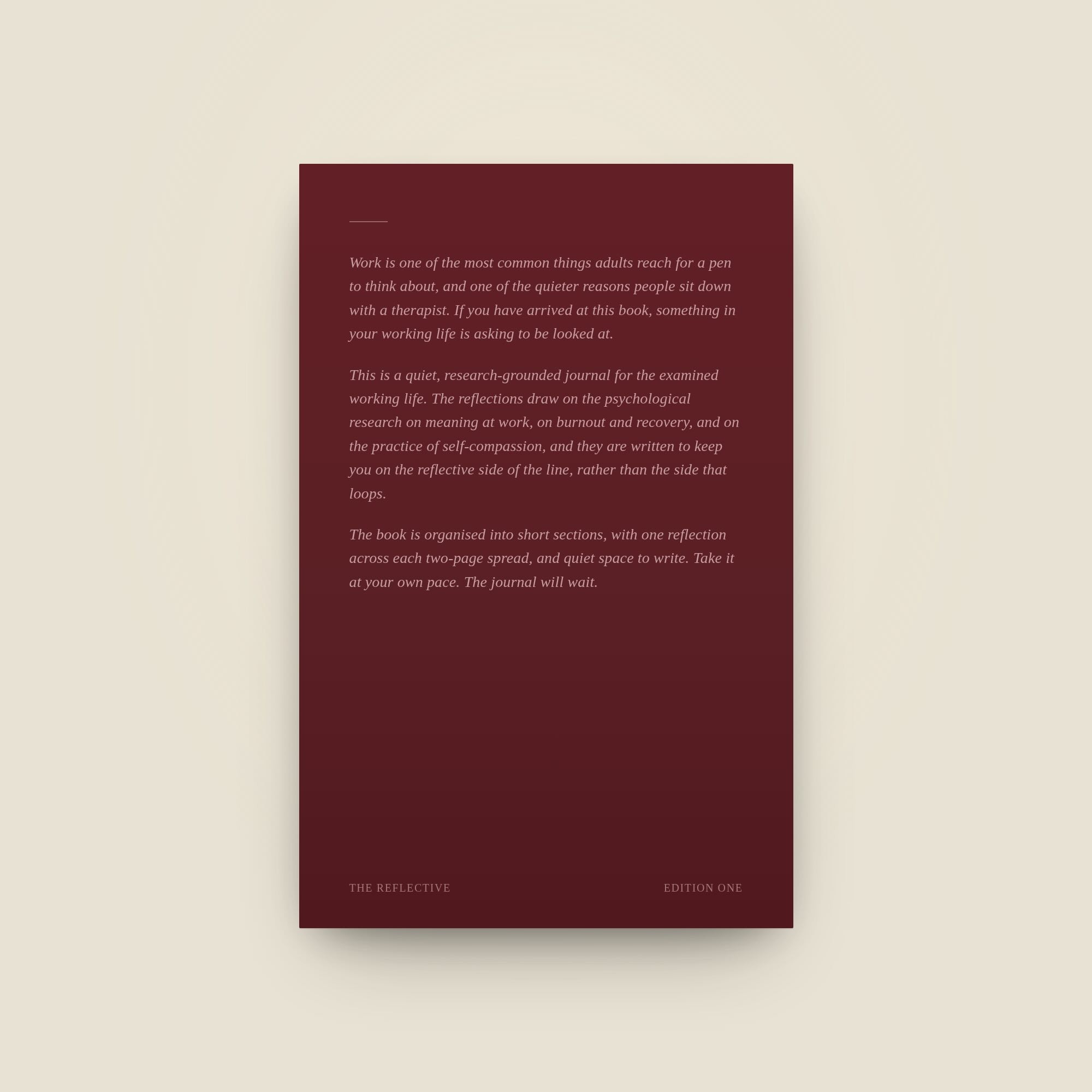
A reflective, guided journal for the examined working life. It offers structured reflection rather than fixing: a place to think honestly about the work you are living, and to notice the direction you want to move in.
What's inside
Ten sections, in order: meeting your working life, your relationship to the work, your values, the body, the self, the people, the harder honesties, the thresholds, what helps, the life you want. One reflection per two-page spread, blank space beneath. A short opening, a close that settles nothing. Begin anywhere.
Draws on the following research
Trapnell, P. D., & Campbell, J. D. (1999). Private self-consciousness and the five-factor model of personality. Journal of Personality and Social Psychology, 76(2), 284 to 304.
Wrzesniewski, A., McCauley, C., Rozin, P., & Schwartz, B. (1997). Jobs, careers, and callings: People's relations to their work. Journal of Research in Personality, 31(1), 21 to 33.
Wrzesniewski, A., & Dutton, J. E. (2001). Crafting a job: Revisioning employees as active crafters of their work. Academy of Management Review, 26(2), 179 to 201.
Maslach, C., & Leiter, M. P. (2016). Understanding the burnout experience: Recent research and its implications for psychiatry. World Psychiatry, 15(2), 103 to 111.
Leiter, M. P., & Maslach, C. (2004). Areas of worklife: A structured approach to organizational predictors of job burnout. In P. L. Perrewé & D. C. Ganster (Eds.), Emotional and physiological processes and positive intervention strategies (pp. 91 to 134). Emerald.
Sonnentag, S., & Fritz, C. (2007). The Recovery Experience Questionnaire. Journal of Occupational Health Psychology, 12(3), 204 to 221.
Edmondson, A. C. (1999). Psychological safety and learning behavior in work teams. Administrative Science Quarterly, 44(2), 350 to 383.
Bridges, W. (1991). Managing transitions: Making the most of change. Addison-Wesley.
Clance, P. R., & Imes, S. A. (1978). The impostor phenomenon in high-achieving women. Psychotherapy: Theory, Research and Practice, 15(3), 241 to 247.
Neff, K. D. (2023). Self-compassion: Theory, method, research, and intervention. Annual Review of Psychology, 74, 193 to 217.